
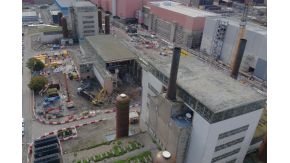
Sellafield plans to demolish Calder Hall Turbine Hall B
PLANS have been submitted to demolish a major building at the world's first full-scale commercial nuclear power station as it marks its 70th anniversary.
Sellafield Ltd has lodged a prior notification with Cumberland Council for the demolition of Turbine Hall B at Calder Hall, near Seascale, just days before the anniversary of the station's opening by Queen Elizabeth II on October 17, 1956.
The application, validated on October 14, forms part of the Calder Land Clearance Project, which aims to remove redundant buildings and free up space for future use.
A public procurement notice published on October 1 reveals Sellafield awarded Amentum Clean Energy Limited a contract worth £14.85 million for five phases of Turbine Hall B demolition.
The contract runs from September 30, 2026, to September 9, 2028, although the planning application gives a wider expected works period ending in November 2031.
According to the application, Turbine Hall B contains a complex of redundant electricity generation equipment within a steel-framed structure built on a concrete raft.
Its external walls are clad in masonry and asbestos-cement sheeting, with a flat roof.
Sellafield says the demolition will 'release a significant land area for reuse' while reducing the costs of maintaining a building which is no longer in use.
The proposed work would involve removing redundant equipment and assessing waste materials before the building is demolished using a wheeled excavator fitted with attachments.
The structure would be taken down to its concrete base, with the foundations and drainage connections initially remaining in place until a future land reuse project is finalised.
The application gives an expected start date of November 14, 2026, and completion date of November 14, 2031.
Cumberland Council has been asked to determine whether prior approval is required for the demolition.
The plans coincide with the 70th anniversary of Calder Hall, which became the world's first full-scale commercial nuclear power station when it was opened by the Queen.
Its four Magnox reactors generated electricity for 47 years before the station closed in March 2003.
In an anniversary announcement published on Friday, October 16, Sellafield said decommissioning was gathering pace, with redundant buildings being removed to create space for infrastructure needed for its future clean-up operations.
Sellafield chief executive Euan Hutton said: "We are safely decommissioning the station and reducing hazards. This creates space we need to support Sellafield’s future mission."
He said space was at a premium on the site, making the clearance work crucial to its future operations.
The company also released a photograph showing demolition progress at one of Calder Hall's turbine halls during 2026.
An accompanying case study published on Thursday detailed the work carried out since Calder Hall stopped generating electricity.
All 40,000 fuel rods have been removed from the station's four reactors, with Calder Hall confirmed fuel-free in 2019.
Its cooling towers were demolished in 2007, while thousands of tonnes of asbestos have been removed from the station and nearby buildings.
Sellafield said further buildings and structures would disappear as decommissioning continued, freeing up land for future facilities and infrastructure, including work supporting the SIXEP Continuity Plant.
The company said experience gained through the programme would help inform similar projects elsewhere at Sellafield and across the Nuclear Decommissioning Authority group.
Separately, Sellafield highlighted plans for Pioneer Park, a proposed clean-energy development on Nuclear Decommissioning Authority-owned land immediately outside the site's boundary.
The project aims to build on West Cumbria's nuclear expertise by attracting new technologies, jobs and investment to the area.
Sellafield plans to demolish Calder Hall Turbine Hall B | In Cumbria
News by Category
- BECBC
- Cumbria
- Nuclear
- Social Value
- Professional Services
- Clean Energy
- Business
- People
- Government
- BECBC Member News